
09/30/2026
FBI Agent Teaches Active Shooter Prevention, Response
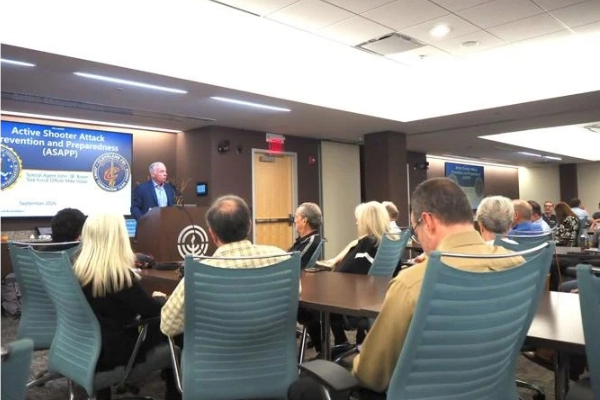
Jim Hartnett, the David P. Miller Director of Community-Wide Security at the Jewish Federation of Cleveland, addresses attendees at the start of the security training Sept. 16 at the Jewish Federation of Cleveland in Beachwood. CJN Photo / Kateryna Kopylchak
Article reprinted with permission from Cleveland Jewish News
by Kateryna Kopylchak
Community members learned how to recognize potential threats and respond during an active shooter situation at a security training on Sept. 16 at the Jewish Federation of Cleveland’s Jack, Joseph and Morton Mandel Building in Beachwood.
The Active Shooter Attack Prevention and Preparedness training, presented by FBI Special Agent John Breen, combined instruction with hands-on demonstrations designed to prepare participants to respond to an active threat.
Jim Hartnett, the David P. Miller Director of Community-Wide Security at the Federation, opened the program by discussing the importance of security within the Jewish community and the Federation’s efforts to provide training and resources.
“I believe that there’s no greater responsibility that we hold collectively than ensuring the safety and security of our community,” Hartnett said.
Hartnett said the Federation invests more than $7 million in community security and works with local and federal law enforcement partners to address potential threats.
Breen, who serves as the FBI’s principal firearms instructor and active shooter coordinator in Cleveland, focused on both preventing attacks and responding when one occurs.
“What we’re going to address today is, I feel, equally, if not more important, and that is prevention,” Breen said.
He told participants that people planning attacks may demonstrate concerning behaviors or conduct surveillance beforehand. Recognizing and reporting those behaviors can give law enforcement information that could help prevent an attack, he said.
Breen encouraged participants to consider the totality of a person’s behavior rather than focusing on one action or characteristic. He discussed warning signs including significant changes in behavior, threatening statements and unusual surveillance of a building or location.
Participants were also encouraged to remain aware of their surroundings and report suspicious activity to security personnel or local law enforcement.
“The goal is, by the end of today, we hope you walk out of here more empowered, more confident, and should you find yourself in one of these situations, you know what to do,” he said.
The second portion of the training moved from discussion to practice. Four volunteers participated in a demonstration showing how people could defend themselves if escaping or hiding were no longer options during an active shooter situation.
Agents assigned participants different roles and walked them through the movements. During one demonstration, a broom was used to simulate a weapon as participants practiced responding to an attacker.
Task force officer Mike Volpe emphasized that fighting should be considered when other options are unavailable and a person’s life is in immediate danger.
“Fight unfair,” he told participants. “You’re fighting for your life.”
The program also included simulated gunfire to give participants an opportunity to apply what they learned in a controlled environment. Participants were informed beforehand about the simulation and could choose not to participate.
The training concluded with agents reviewing additional safety considerations and answering questions from attendees.
Hartnett said programs like the active shooter training are part of the Federation’s broader effort to help Jewish institutions and community members prepare for emergencies while maintaining an active and open Jewish community.
