
07/31/2026
NYC Jewish Museum Director to Discuss Israeli Art Aug. 3
Article reprinted with permission from Cleveland Jewish News
by Jimmy Oswald
Coming to Cleveland is a double dousing of special for James Snyder. Not only are there personal roots established in the community – his wife, Tina, is a born-and-bred Clevelander with family still very present – but the area’s vibrancy in the Jewish arts and cultural world is of special interest to the director of The Jewish Museum in New York City.
“I’m from the Monongahela River Valley, south of Pittsburgh, and growing up, Cleveland was like a wannabe home for me because it had mass transit, a great museum and was a bustling city,” Snyder told the Cleveland Jewish News. “I started at the Museum of Modern Art (in New York City) in 1974, and we did a lot with the Cleveland museum (Cleveland Museum of Art) Even though it wasn’t just modern, it’s a grand, encyclopedic museum. And the then-director Sherman Lee was one of the great museum directors. Their modern contemporary program was strong. From day one, Cleveland’s always been a city for me.”

Snyder
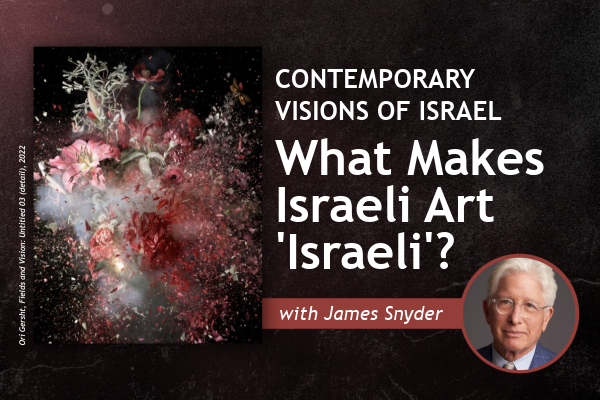
Snyder will discuss what he has learned through his years of interacting with Israeli art and artists in “What Makes Israeli Art Israeli?” presented by the Jewish Federation of Cleveland and Contemporary Visions of Israel. The program will be held at 6 p.m. Aug. 3 at the Federation’s Jack, Joseph and Morton Mandel Building at 25701 Science Park Drive in Beachwood.
“The fact that the Jewish community in Cleveland is so robust and a lot of it is involved with culture, really makes it a very dynamic place,” he said. “So, it’s always exciting to be there.”
Snyder was the deputy director of the Museum of Modern Art before serving as the Anne and Jerome Fisher Director of The Israel Museum in Jerusalem from 1997 through 2016. After becoming director emeritus, Snyder was the museum’s international president through 2018 and was executive Chairman of The Jerusalem Foundation, Inc., from 2019 through 2023, when he joined The Jewish Museum in New York City.
During his time at The Israel Museum, Snyder said he and his team developed a narrative around definitional universalism – how all cultures connect across time and around the globe.
“The museum was archaeology and prehistory through the diaspora of Islamic culture and Jewish world culture over the last thousand years where the material dimensions of Jewish culture really expressed themselves worldwide,” he said. “And then there was art history, Western cultures and all non-Western cultures – but because we were in Israel, Western fine art for us started in Israel and went backwards.”
The museum brought a culture Snyder was unfamiliar with, because he had just moved to Israel, and brought it into the picture “in a big way” and demonstrated how culture over the last 100 years as art, separate and apart from religion.
“The religious roots of Jewish ceremonial art evolved in Israel, separate and apart, but also integrated with other cultures,” he said. “And so being now back in the United States and now being at The Jewish Museum, where we’re telling the story of 3,500 years of Jewish culture, wandering the global diaspora and coming to the present, where modern and contemporary play a key role, I find it very exciting to have the opportunity to talk about Israeli art and Israeli culture today and how it fits into a bigger picture.”
Showcasing how Israeli art today fits into the bigger narrative has only become more important since the Oct. 7, 2023, Hamas-led invasion of Israel, Snyder, who became The Jewish Museum’s director three weeks after the attack, said.
“In the last couple hundred years of the flowering of art not connected to narrative representation of religion included Israel and does include Israel,” he said. “In our new collection galleries, which we’re going to talk about, we do tell a story of 3,500 years of Jewish culture in the global diaspora, integrating, not segregating, archaeology, ceremonial, historical, modern, contemporary, putting them all together. Among 250 objects on view, about 90 artists and artisans are alive, and a third of them are Israeli. “And we made a very strong point of having Israel in that picture because since Oct. 7th, it’s been very contentious to think through this whole thing about where is or isn’t Israel and where is or isn’t Jewish culture. It’s been a point of pride to be able to integrate Israeli art into our story.”
As Snyder looks to the future of Jewish art and life, he reflects on a moment when he first arrived at The Israel Museum.
“When I got to The Israel Museum, there was a wing devoted to Judaica and Jewish ethnography,” he said. “I said, ‘Forget that. We’re calling it Jewish art and life.’ And that’s how the world needs to evolve. So the more that museums, not in a self-conscious way, but in an organic way, bring Jewish culture and braid it into the narrative and do the same with other cultures – Latino culture, Hispanic culture, African and African American cultures – bring these cultures into a continuum of narratives, the better.”
To register, visit https://www.jewishcleveland.org/news/upcoming-events/ciac_presents_what_makes_israeli_art_israeli.
