
02/05/2026
After October 7, 2023: Cleveland's Jewish Community Defies the Dark
Article reprinted with permission from Cleveland Jewish News
by David Hertz, Special to the CJN
A few weeks after the bloodiest attack on Jews since the Holocaust, a small group of Northeast Ohio leaders traveled to Israel and met with family members desperate for news about loved ones taken hostage to the Gaza Strip by Hamas. In those waning days of October 2023, Israel was still determining who was among the more than 251 hostages, and who had been killed.
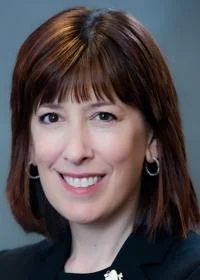
Rudin-Luria
“While we were on the trip, we learned that one of the young women (of the family members) had been killed in captivity,” Erika B. Rudin-Luria, president of the Jewish Federation of Cleveland told the Cleveland Jewish News in a one on one interview via Zoom on Feb. 1. “There was very little we could do except support the people of Israel. And one of the clear ways we could support the people was by advocating for the return of the hostages.”
Less than two months later, Federation erected a 15-foot ribbon designed by Nancy Schwartz-Katz and championed by Sharon Rosenbaum, outside the Jack, Joseph and Morton Mandel Building in Beachwood.
Rudin-Luria recalled that trip and the community response as she reflected on a tragic victory. Days prior to our interview, Israel Defense Forces soldiers had recovered the remains of Master Sgt. Ran Gvili – the last hostage from the Oct. 7 attack – and restored him to his family. Their action ended one of the darkest chapters in recent Jewish history. Oct. 7 not only shattered lives in Israel – it reshaped the Jewish experience of communities like Cleveland and redefined resilience, responsibility, and connection. Today, for the first time since the horrors of Oct. 7, American Jewish communities are faced with a simple question: What comes next?
The answer is as complex as the post-Oct. 7 world. Jewish communities face immense pressures from record antisemitism and anti-Israelism coming at them from all angles. In response, Jews have reached out to their community institutions, seeking to strengthen existing bonds and to build new ones.
A “surge” of outreach
In March 2025, the Jewish Federations of North America repeated a survey it had done a year before to gauge the impact Oct. 7 had on Jews and their communities. The results in 2024 and 2025 identified a “surge” of engagement and interest.
“The surge appears to be linked to the emotional impact of the war and significant concern about antisemitism,” the organization wrote in a blog post about the findings. “Seventy-nine percent of Jews said they were deeply concerned about antisemitism.”
The post also spoke about a desire for connection.
“Seventy-three percent of those in the ‘surge’ expressed a desire to learn. They said they didn’t only want to better understand current events in Israel and the history of the Arab-Israeli conflict, but also wanted to increase their Jewish knowledge to gain a deeper connection to the community and understand their identity.”
Rudin-Luria said this “surge” has been noticeable in Cleveland and will help guide the Federation as it takes steps to move the community forward.
“Cleveland tends to score higher in engagement,” she said. “There is no doubt that we saw major evidence of the ‘surge.’”
She cited attendance at events such as the Oct. 9, 2023, rally at Federation’s Jack, Joseph and Morton Mandel Building that attracted 1,000 community members – Jewish and non-Jewish.
Rudin-Luria cited the size of the turnout and the diversity.
“The numbers that we’re seeing and the diversity within the numbers of people from all parts of the Jewish community, and frankly, people that we did not know before, coming out to events,” she said. “Community is the best antidote to isolation.”
Moving forward through collaboration
Rudin-Luria acknowledges the hate-driven challenges Jewish communities face, and the Federation’s commitment to work with other institutions to build a thriving future regardless of headwinds. But her view of the future includes the community translating hate into strength, opportunity and collaboration.
“There’s a saying. ‘If you want to go fast, go alone. If you want to get far, go together,’” she said. “We’ll do it together. Everything that our professionals do at Federation, we do in partnership with our volunteer leadership and in partnership with the agencies in our community and the synagogues in our community, and now the security in our community. There’s no question in my mind that we will move forward. There’s no point to surviving if you’re not going to thrive… And so that’s what you rededicate yourself to. Not fighting, but a thriving, vibrant Jewish life. And that is how we will move forward.”
In March 2024, in the wake of growing antisemitism and anti-Israel protests in the United States, The Atlantic magazine published a cover story titled, “The Golden Age of American Jews is Ending.”
Rudin-Luria sees the future differently for the Jewish community in Cleveland and the country.
“Is it the Golden Age is over, or is it that we woke up and that we didn’t realize that those illiberal enemies of the Jewish people had been quietly at work this whole time while we were celebrating our success?” she asked. “You know, we’re a very determined people, so I wouldn’t count us out. … The fact that we need the security we have is exceptionally disturbing. We have the security that we have so that we’re able to engage fully in our Jewish lives.”
Still, in the United States and much of the world, Jews are likely to continue to feel the impact of hate, she said.
“Right now, it’s acceptable to hate Jews,” Rudin-Luria said.
“I was listening to a podcast that suggested that we stop the debate over semantics,” she said. “Is it antisemitism? Is it anti-Zionism? And the podcast speakers suggested, look at the actions. When someone burns a synagogue, that’s hate. It doesn’t actually matter what they’re calling themselves. … It is a very tough time for the Jewish people, and I think we need to keep our eyes open.”
When communities overlap, you must find your voice
On Oct. 8, 2023, Rudin-Luria hosted a lunch for a group of young Israelis that were in Cleveland on an exchange program. Her young adult sons joined the meal as well.
“I knew all I could do that day was feed them and wrap my arms around them,” she said. “And they’re all army age, and they went around the table, and we knew so little on Oct. 8, but even what we knew at that point was so horrible. And one by one, they went around and said, you know, this brother of mine was called up. …
“And in that moment, I knew that our lives were forever changed. And afterwards, I remember my husband (Senior Rabbi Hal Rudin-Luria of B’nai Jeshurun Congregation) and I talking to our kids about this, and saying to them, you know, the ground has shifted forever. And we told them that they needed to find their voices and find it quickly.
“I would not have imagined how quickly hate would emerge in schools, you know, on campuses, but I said to them, we do not have privilege of staying silent … then reality (hit) and the hate that would emerge was far worse than anything I could have imagined.”
Hate attacks the Jewish community from all sides
In a polarized world, the Jewish community faces intense pressure and condemnation from what some call “horseshoe antisemitism,” where hate comes from both the political far left and the far right.
“It seems to have crawled out of every corner, and we and our partners are seeing a campaign that’s really about the systemic delegitimization of the Jewish people, mainstream institutions, Jewish leaders,” Rudin-Luria said. “It’s like they’re illiberal. It’s not enough that if you’re liberal and progressive, it’s not enough if you care about Palestinians, anything short of disavowing Israel, anything short of denying Israel’s right to exist, means that you’re on the outs, and we’re seeing major pressure to convert” political views.
The result is that in schools, on college campuses, in social media, Jews are being told to disavow their upbringing, she said.
“Get rid of your identity,” Rudin-Luria said. “Get rid of where you come from. Get rid of your family history. All of it’s false. Your parents lied to you. Your rabbi lied to you. Everything you’ve been told before you must disavow.”
Federation is committed to helping public and private schools address this type of hate.
“We get lots of requests and questions from schools,” she said, adding Federation wants to be responsive. “If they have a challenge, Access Jewish Cleveland will help them navigate that challenge.”
The complex struggle to discover what comes next
Jewish communities are likely to take years to answer the question of, “what comes next?” After all, as Rudin-Luria said, addressing the challenges of hate requires the courage of finding a voice, using it and committing to collaboration within a complex community. But perhaps part of the Cleveland Jewish community’s way forward, as Rudin-Luria describes it, lies in its commitment to Israel and the families so intimately impacted by Oct. 7.
Of all the families Cleveland’s community connected with after the attack, they formed the closest relationship with the family of Mazal and Shlomo Mansour. During the attack, Mazal and Shlomo were abducted. Mazal managed to escape; Shlomo, 85, was taken to Gaza and murdered.
Even though Rudin-Luria and the Federation team met with the Mansour family in their home, they were initially reluctant to embrace the Jews from Cleveland.
“They were whispering to each other, and looked back at us and said, ‘You know, we have a feeling that this relationship is going to be different,” she said. “That you’re going to be like family to us.”
On the day before Shlomo’s funeral, Rudin-Luria and Mark Holz, chair of the overseas connections committee, met with the family in Israel. Rudin-Luria recalled one of Mansour’s daughters said, “’You know, so many people disappointed us during the last two years. Over and over again, we felt disappointments, but every time we turned around, there you were. Cleveland was like a light in the darkness.’”
Rudin-Luria explained further.
“I’ve found that travel to Israel right now is about not only showing up the first time but showing up the second and the third time. … You continue to support them,” she said.
Support for Israel, for Cleveland’s Jewish community, comes in many forms. It is evident in the $36 million the Jewish Federation of Cleveland raised in the Israel Emergency Campaign, and in the $20 million Federation raised to meet other trauma-related needs. It comes in the form of moral and emotional support. And in the form of a 15-foot memorial.
Now that all hostages have been returned, Federation is advancing plans to replace the ribbon with a permanent memorial. Like the ribbon, they sought approval and received variances from the city of Beachwood in November 2023 to face Richmond Road for greater impact and exposure.
Cleveland. A light at the end of a dark chapter.
David Hertz is a life member of the Cleveland Jewish Publication Company Board of Directors. He is writing for the CJN pro-bono as a freelance journalist.
To watch the video interview, visit cjn.org.
About this series
The Impact of Hate, a CJN series, aims to shed light on the rising tide of hate affecting our community. This ongoing feature will go beyond individual incidents to explore how hatred impacts our children, families, communities, and country as a whole. Reporting and writing on this series for the CJN is David Hertz, a former Akron Beacon Journal newsroom editor, CJN columnist Regina Brett, and periodic guest contributors.
