
06/16/2026
Jewish Leaders Highlight Depth of Jewish Cleveland
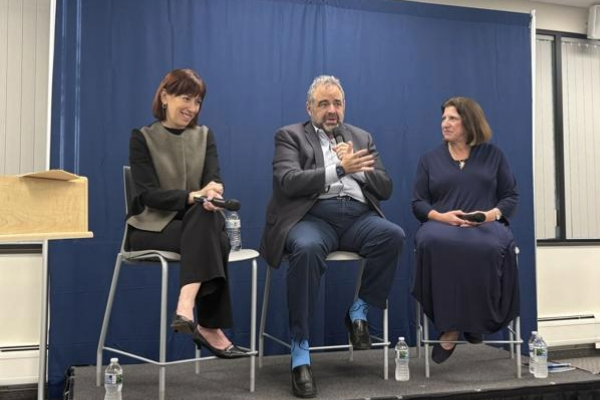
Jewish Federation of Cleveland President Erika B. Rudin-Luria, Mandel JCC President and CEO Jesse Rosen, and Marlyn Bloch Jaffe, CEO of the Jewish Education Center of Cleveland discuss the institutions they lead and how they work together with other organizations. CJN Photo / Shawna Polster
Article reprinted with permission from Cleveland Jewish News
by Martha Sorohan
Leaders of three local Jewish organizations said that when it comes to collaboration, Cleveland’s Jewish community is all in.
Erika B. Rudin-Luria, president of the Jewish Federation of Cleveland, Jesse Rosen, president and CEO of the Mandel Jewish Community Center of Cleveland, and Marlyn Bloch Jaffe, CEO of the Jewish Educational Center of Cleveland, discussed “Great Institutions of Cleveland: Jewish Organizations” on June 9 at Landmark Center in Beachwood.
Sean Martin, associate curator for Jewish history at the Western Reserve Historical Society, moderated the discussion, part of Case Western Reserve University’s Laura and Alvin Siegal Lifelong Learning program.
“People show up for each other in Cleveland,” Rudin-Luria said. “The Jewish community is different from what I’ve seen anywhere else.”
Bloch Jaffe said, “We support 42 partner organizations, going to direct service to fill the gaps.”
Rosen said, “It’s just different here. You can feel it. Different generational connections among people, programs, donors. Fourth-, fifth- and sixth-generation families still live in Cleveland.”
Rosen said that Jewish roots in Cleveland are far deeper than those in West Palm Beach, Fla., where he was head of the JCC for six years before coming to Mandel JCC 18 months ago.
“West Palm had no families prior to the advent of air conditioning,” he said. “Here? You go back 100 years. People say, ‘Oh, we decided that 60 years ago.’ As they say, if you don’t know where you come from, you don’t know where you’re going.”
Collaboration was at the heart of the 1903 creation of the oldest of the three organizations, the Federation, as well, its donors desiring to pool funds “the federated way” with a single fund-raising campaign, according to Rudin-Luria.
“We evolved within the community and prioritize around the needs of the Jewish community,” she said. “And by ‘we,’ I ’m talking about the JCC, Jewish Family Services (Association), and others. That’s how we see ourselves. Who is best situated to meet the needs?”
Some of the needs evolved because Jews were shut out of other institutions, such as hospitals and country clubs, but over the generations, it has become easier to be Jewish in America, the panelists said.
“We were once teaching Jews how to be Americans,” Rosen said. “Now we are teaching Americans how to be Jews. We create community, a place to feel safe, be at home, be leadership. These are career moments I never knew I’d have.”
Bloch Jaffe has found that because people connect to Judaism in “myriad ways.” Her organization uses innovative options to support partner institutions serving schools and youth, she said, and cited its jHUB program that works with interfaith families.
“No one else did it,” she said.
In Cleveland, Jewish organizations don’t care which one gets credit, according to Rosen.
“We’re frustrated if we duplicate services,” he said. “It’s a waste of funds if we’re competing. But if partners can’t, or won’t, we do it.”
When asked what surprised them most about leading their respective agencies, Block Jaffe said it was that she is leading a legacy institution dating to 1924, founded as the Bureau of Jewish Education with Rabbi Abba Hillel Silver its first president, then reorganized and renamed in 1993.
“To be entrepreneurial is tremendous,” she said. “There’s no road map. The employees have the latitude to connect with our partner institutions.”
Rosen said that he is “surprised at how big Cleveland can dream and think, – $75 million capital campaigns. These numbers don’t happen anywhere else. It’s amazing – the community coalescing. Nothing stops it – the idea that we have leaders to push and fund bigger ideas.”
Rosen said that the $60 million grant awarded the Mandel JCC in March by the Mandel Supporting Foundation was the largest grant received by any JCC in North America.
“We are the Mandel Jewish Community Center, so we serve Jews first, but our strength is that we have opportunities to Jews and non-Jews to come together,” he said. “The 7-year-old non-Jewish kid in our after-school program with dozens of Jewish kids is less likely to grow up to hate Jewish kids. We don’t ask, ‘Are you Jewish?’ We ask, ‘What’s Jewish?’ It’s definitely in the eye of the beholder. Our job is to create the Jewish experience for anyone who wants it. Jews, in whatever form they are, keep coming.”
To watch the panel discussion, visit youtube.com/watch?v=C9mNjyYWKaY.
