
10/05/2026
Middle East Expert Discusses Middle East Policy, Israel
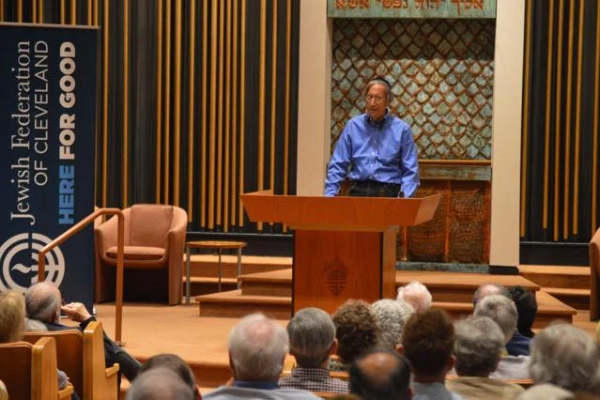
Aaron David Miller, senior fellow at the Carnegie Endowment for International Peace, speaks on Middle Eastern affairs at Suburban Temple-Kol Ami in Beachwood on Oct. 1. CJN Photo / Casey Swinarski
Article reprinted with permission from Cleveland Jewish News
by Casey Swinarski
“The dividing line for effective foreign policies in this country is not between left and right, between liberal or conservative, or between democrat and republican,” Aaron David Miller explained. “It’s between smart on one hand, and dumb on the other.”
However blunt, the concept of transcending partisan loyalty to strive for policies that benefit the whole, is a concept that Miller said exists in a galaxy far, far away.
“It’s been lost, and it is clearly one of the steps necessary in a recovery process,” Miller, who emphasized his past ballots have been cast for both blue and red in the past, said.
Miller, the senior fellow at the Carnegie Endowment for International Peace and a leading expert on U.S. foreign policy and the Middle East, shared these thoughts and others on Oct. 1 at Suburban Temple-Kol Ami in Beachwood in a talk titled “Navigating the Middle East,” hosted in partnership by the Jewish Federation of Cleveland and Suburban Temple-Kol Ami, both in Beachwood.
A veteran diplomat and longtime Middle East negotiator, Miller spent 25 years at the U.S. Department of State, advising six secretaries of state and participating in efforts to advance the Arab-Israeli peace process.
During the talk, Miller began by explaining that the key to understanding why the U.S. behaves the way it does in terms of foreign policy is quite simple, and it all comes down to geography.
“Location is critically important to understanding why we behave the way we do and why the countries that we deal with react the way they do,” he said. “We have nonpredatory neighbors to our north and south, and to our east and west, we have fish.”
That is why President Donald J. Trump’s Operation Epic Fury airstrikes on Iran on Feb. 28, 2026, demonstrated what Miller called a “war of choice,” and one that he said may have set the regime’s nuclear program back a few years, but ultimately did not lead to a total resolution of conflict.
“The war of choice, in my opinion, overestimated the American military, and underestimated the resilience of a brutal, repressive, authoritarian regime that was determined to survive,” he said.
“Once scientific knowledge enters the head of the scientific community, once you have capacity, there’s no way to stop Iran if they choose to weaponize, except to eliminate their desire to acquire a weapon, which would mean a new regime, and frankly, to my knowledge, we cannot produce this.”
On Israel, Miller shared that Trump has done things that no other U.S. president has ever done, setting a precedent for what he is “allowed” to do.
“He upended up a dialogue with Hamas over the Israeli government’s objections, he had a deal with the Houthis and obviously Israelis learned after the fact,” Miller said. “He leaked his profanity-laced conversation with Binyamin Netanyahu mocking the Israeli prime minister. No president I ever worked for would ever do anything like that, and he has set a new sort of benchmark of what you can do with or to Israel without consequence.”
Looking forward, the only reasonable solution to the Israel-Palestinian conflict is “separation through negotiations,” Miller said. A one-state solution would not be a long-term solution.
“Israel has to become a democracy for all,” he said, referencing the Palestinians who reside in Israel.
And what will bring this end? Strong leaders and moral responsibility, Miller said, before wrapping up with a quote from President John F. Kennedy – “idealism without illusions.”
“He said it, and I embraced it,” Miller said. “Never give up on the possibility of change, but as you go through the process of change, you got to go through the right way.”
