
04/16/2026
Never Forget: ‘The Enduring Impact of the Holocaust’
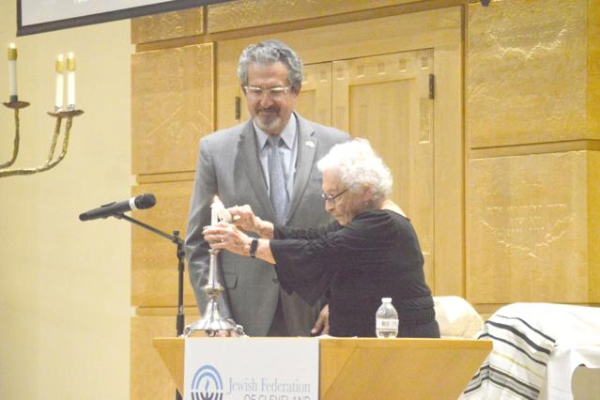
Erika Gold, a Holocaust survivor and Beachwood resident, lights a candle, while Mark Frank, Kol Israel Foundation past president and lifetime director, looks on during the Yom Hashoah V’Hagvurah commemoration at Congregation Mishkan Or in Beachwood on April 13. CJN Photo / Jimmy Oswald
Article reprinted with permission from Cleveland Jewish News
by Jimmy Oswald
Holocaust survivor Erika Gold of Beachwood scanned the crowd of over 500 people gathered at Congregation Miskhan Or in Beachwood on April 13 for the Yom Hashoah V’Hagvurah commemoration and delivered a message for everyone to take home with them: “Learn our history. Share it. Don’t forget it.”
The annual event, presented by the Jewish Federation of Cleveland, in partnership with Kol Israel Foundation, explored the Holocaust’s far-reaching effects across four interconnected spheres – individual, family, community and global. The commemoration’s theme this year was “From Trauma to Transformation: The Enduring Impact of the Holocaust Across Generations.”
In addition to Gold, speakers included other Holocaust educators, descendants of survivors, and relatives of those killed during the Holocaust.
Gold was born in Hungary in 1932. She witnessed her father being sent to a labor camp and was later forced onto a Nazi truck with her mother. They managed to escape and hide with a former housekeeper until liberation. After the war, they reunited with her father, immigrated to Cuba in 1948, and moved to Cleveland two years later.
Gold was also honored with the 2025 Cleveland Jewish News 18 Difference Makers Sam Miller Lifetime Achievement Award, as well as a member of the inaugural class of CJN 18 Difference Makers in 2015.
“As it turns out, the Holocaust survivors didn’t just survive, they thrived,” Gold told the audience. “They built businesses and organizations. We were able to change the Cleveland area as much as we could. We were successful.”
Gold said education is important, and she often emphasizes that point when sharing her story with schools and student groups.
“I always tell them to take advantage of their education because that’s the only thing they own,” she said. “Everything else can be taken away from them, but not what they have in their own heads. So, we pass that on to our children and grandchildren and hope they listen.”
Co-chairs Erica Hirsh and Jordan Walman, both of whom are third-generation descendants of survivors and serve on the board of the Kol Israel Foundation, opened the commemoration, expressing gratitude for the opportunity to “reflect and honor the lives and legacies of those who endured the Holocaust.”
“My grandparents, Herman and Esther Frank, survived the Holocaust and rebuilt their lives with remarkable strength,” Walman told the community members. “It is a privilege to carry forward their legacy.”
“My grandfather, Harry Abraham, survived Kristallnacht along with his parents,” Hirsh said. “Like Jordan, I feel a deep responsibility to preserve and share these stories. ...We invite you to reflect on memory, identity and the enduring connection across generations.”
The presentation of colors by Jewish War Veterans then followed before the March of Generations, with young children and teens proceeding around the room holding candles to signify the importance of future generations.
A Torah scroll procession with representatives from Congregation Mishkan Or, B’nai Jeshurun Congregation in Pepper Pike, Congregation Shaarey Tikvah in Beachwood, Gross Schechter Day School in Pepper Pike, Oheb Zedek Cedar Sinai Synagogue in Lyndhurst and Temple Israel Ner Tamid in Mayfield Heights occurred before Rabbi Joshua Caruso of Congregation Mishkan Or delivered the invocation.
A moment of silence was held with an audible siren, before Cantor Kathryn Wolfe Sebo sang the national anthem. Cantor Vladimir Lapin then joined her musical presentations of “Ashrei HaGafur” and “Eli, Eli.”
A candlelighting ceremony followed, with those who work to educate and preserve the history of the Holocaust and descendants taking to the podium to share their stories before igniting the candle wicks.
Amy Nadler, chair of Jewish Volunteer Network and a volunteer with Jewish Family Service Association’s Holocaust Survivor Legacy Project, an initiative supported by the Federation that created a book after interviewing survivors to tell their firsthand accounts of their childhood Holocaust experience and their life after World War II, spoke about the initiative.
“It is the objective of the Legacy Project to highlight the resiliency and healing that allowed survivors to continue to lead meaningful lives, even after the atrocities they experienced,” she said. “These books are keepsakes for their families and can be used for educational purposes for future generations.”
Jeffrey Kaplan, who has dedicated his life to Holocaust education and joined Kol Israel Foundation’s Face-to-Face program in 2013, said it is “much more than a Holocaust education program.”
“Through our stations, poster displays, personal stories and interactions with the students who participate, we demonstrate how hatred, bigotry, and narrow mindedness can lead to disastrous results not only in the past, but today.”
Alan Rosskamm shared how his parents were forced to flee Germany as Jews’ rights began to be taken away as the Nazis rose to power. Other family members also endured Kristallnacht, escaped on the Kindertransport and fought in the war.
“As our kids were growing up, I would ask an older member of the extended family to tell their personal exodus story of leaving the impression of a modern day pharaoh: Adolf Hitler,” he said. “And they were reluctant to tell those stories. They had to be pushed. But, each story was more remarkable than the last.”
Ruth Gruenspan Wolfson, her sister Rebecca Gruenspan, and father Charles Gruenspan, told the story of Abrahaman Gruenspana, a Polish Army officer who was taken prisoner by the Soviets during World War II and spared because he was able to read Russian blueprints. Tova Gruenspan had to flee Czechoslovakia during the war and met her future husband in a displaced persons camp in Landsberg.
“It’s been at my core to create a Jewish home, keep their stories alive and hold our family bonds together even as the generations get further and further apart,” Wolfson Gruenspan said. “They would have wanted it that way.”
Mark Swaim-Fox, vice chair of the Ohio Holocaust and Genocide Memorial and Education Commission, which brings government officials, educators and others together to make Holocaust and genocide education more accesssible, said there is still a lot of work left to do.
“Too many students still don’t really know this history in a meaningful way,” he said. “And at the same time, we’re seeing a rise in antisemitism globally, nationally and here in Ohio. That’s exactly why the commission exists. …At the end of the day, it’s about carrying forward these voices and these stories, especially as we move into a time when we won’t have survivors with us in the same way. The responsibility shifts to all of us.”
Suellen Kadis and her son, Justin Kadis, who accepted the Roslyn Z. Wolf Cleveland-JDC International Fellowship to become the director of external relations at the Jewish Community Center in Krakow, Poland, where he worked just 60 miles from Auschwitz-Birkenau, talked about the work that JCC Krakow does, which includes serving dozens of Holocaust survivors. He also helped establish a bike ride from the camp to JCC Krakow to raise funds from survivors and Jewish renewal.
“The Jewish story in Krakow today is not one of victimhood. It is one of responsibility,” Justin Kadis said. “If the community can be decimated, driven underground for decades and still find a way to rebuild Jewish life, then we have no excuse not to go. We are not rebuilding what once was, that world is gone. We are building something new.”
Erika B. Rudin-Luria, president of the Jewish Federation of Cleveland, delivered closing remarks, saying it is more important now than ever before for the Jewish community to stand together, regardless of differences.
“Together, we share memories and history,” she said. “ We are together in times of celebration and in times of trauma. We cannot change the past, but we are obligated to learn from it and to take action informed by that knowledge.”
Lapin led the memorial prayers and the song of the partisans before Sebo led the audience in the singing of the Israeli National Anthem, “Hatikvah,” to conclude the program.
